


This morning gave us a clean signal, if you're paying attention.
The 10-Year Treasury moved higher by roughly 5 basis points. Uniform Mortgage Backed Securities dropped more than 25 basis points. That is not noise. That is structure.
There is a clear relationship right now between rising oil prices, rising Treasury yields, and declining MBS prices. When MBS prices fall, interest rates rise. That is what directly hits the American household. You can ignore the headlines if you want. The bond market is not.
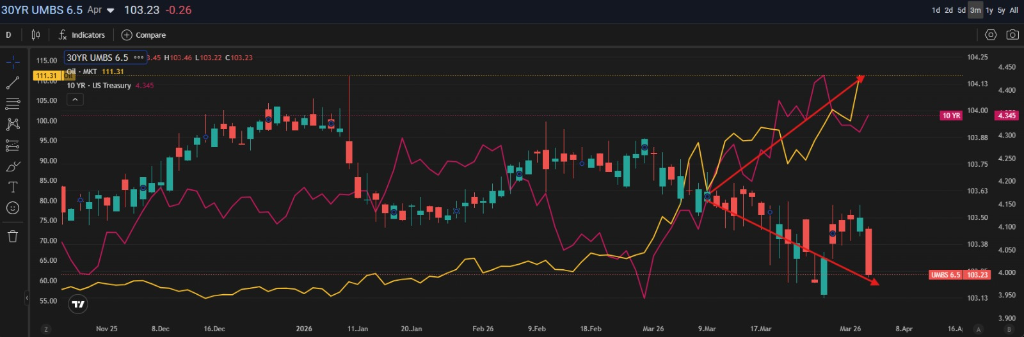
30YR UMBS 6.5 vs. 10-Year U.S. Treasury — April 2-3, 2026 (Source: MBS Live)
This Market Is Being Driven by Uncertainty
The move we saw was not about long-term fundamentals. It was about reaction. Geopolitical tension pushed oil higher. Oil pressured bonds. Then a shift in headlines around potential de-escalation reversed the move and brought partial recovery.
One speech moved the market. One headline reversed it. That tells you everything. We are not in a stable environment. We are in a reactive one.
The Jobs Report Does Not Tell the Whole Story
Today's jobs data, on the surface, looks solid. March payrolls came in at 178,000 — nearly three times the 59,000 consensus estimate. Unemployment ticked down slightly to 4.3%, better than the 4.4% forecast. Wages came in softer than expected.
If you stop there, you would say the economy is holding. But that is not what the market is reacting to. Because the reality is more nuanced. A stronger jobs report does not automatically mean relief for the American household. In fact, in this environment, it can mean the opposite. Stronger labor data keeps pressure on the Federal Reserve to hold rates higher for longer. And higher for longer means continued pressure on mortgage rates, affordability, and cost of living.
So while the headline reads strength, the consequence is restraint. That is the disconnect.

What Americans Are Actually Feeling
There is a gap between what gets reported and what people are living. Americans understand global threats. They understand that not every country respects our values or our way of life. At the same time, they are under real economic pressure. Not political pressure. Economic pressure.
What used to be a goal — a six-figure income — is now a requirement just to maintain baseline stability.
- Mortgage payments between $3,000 and $5,000 a month
- Health insurance north of $1,000 a month
- Childcare running $300 to $500 a week
That is not luxury. That is baseline.

The Middle Class Is Carrying the System
The conversation keeps getting redirected to the same place. Tax the rich. That is convenient. It is not complete.
The top 10 percent already pays the majority of federal income taxes. They also have the capital to absorb volatility. The bottom half contributes less and receives the majority of benefits. The group being compressed is the middle — the top 40 percent that carries a significant portion of the tax base while also absorbing rising costs. They fund the system. They fund growth. And right now, they are being squeezed from both sides.
We Are Asking the Wrong Question
The federal government brings in roughly four trillion dollars in annual revenue. That does not include state and local collections. The issue is not whether we need to take more from one group or another. The issue is how the money already being collected is being allocated.
That is the conversation most people are not having. Because once you shift the focus from who to tax to how money is managed, accountability becomes unavoidable.

Why Housing Still Matters Most
Everything ties back to housing. If interest rates remain elevated, affordability remains constrained. When affordability is constrained, transactions slow. When transactions slow, mobility slows. When mobility slows, the economy tightens.
Most small businesses still rely on home equity as a primary source of capital. No access to affordable housing means no access to capital. No access to capital means limited growth. You cannot have a strong economy without a functional housing market.
Where We Are Right Now
The bond market is signaling caution. Today's recovery was not built on strength. It was built on hope. Hope that geopolitical tension eases. Hope that oil stabilizes. Hope that inflation pressures do not re-accelerate.
And now, even with a strong jobs report showing 178,000 new jobs added in March, the reality is the same. Rates are not coming down quickly. The market is waiting for confirmation, not reacting to headlines. This is not a market that rewards emotion. It rewards discipline.
This Is Bigger Than Politics
This is not about party lines. This is about whether the system is working for the people inside of it. Every administration has an opportunity to improve the lives of Americans. That responsibility does not change with the party in power.
Right now, the priority should be clear. Stabilize interest rates. Support housing. Strengthen the economic foundation that families and businesses actually rely on.
Final Thought
The world is unstable. That is not new. But stability at home is still within our control. If families can afford to live, if they can access housing, if they can build equity, everything else has a chance to work. If they cannot, nothing else will.
And the bond market, whether people realize it or not, is already telling us that something needs to adjust.
Sources and Market References
- U.S. Bureau of Labor Statistics — Employment Situation Report, March 2026 (Released April 3, 2026)
- CNBC — Jobs Report, March 2026 (Published April 3, 2026)
- U.S. Department of the Treasury — 10-Year Treasury Yield Movements (Week of April 1-3, 2026)
- MBS Live — Daily MBS Pricing and Market Commentary (April 2-3, 2026)
- U.S. Energy Information Administration — Crude Oil Price Movements (Week of April 1-3, 2026)
- Reuters — Middle East Tensions and Strait of Hormuz Developments (April 2-3, 2026)
- Federal Reserve — Recent Policy Commentary and Rate Outlook (Late March - Early April 2026)